
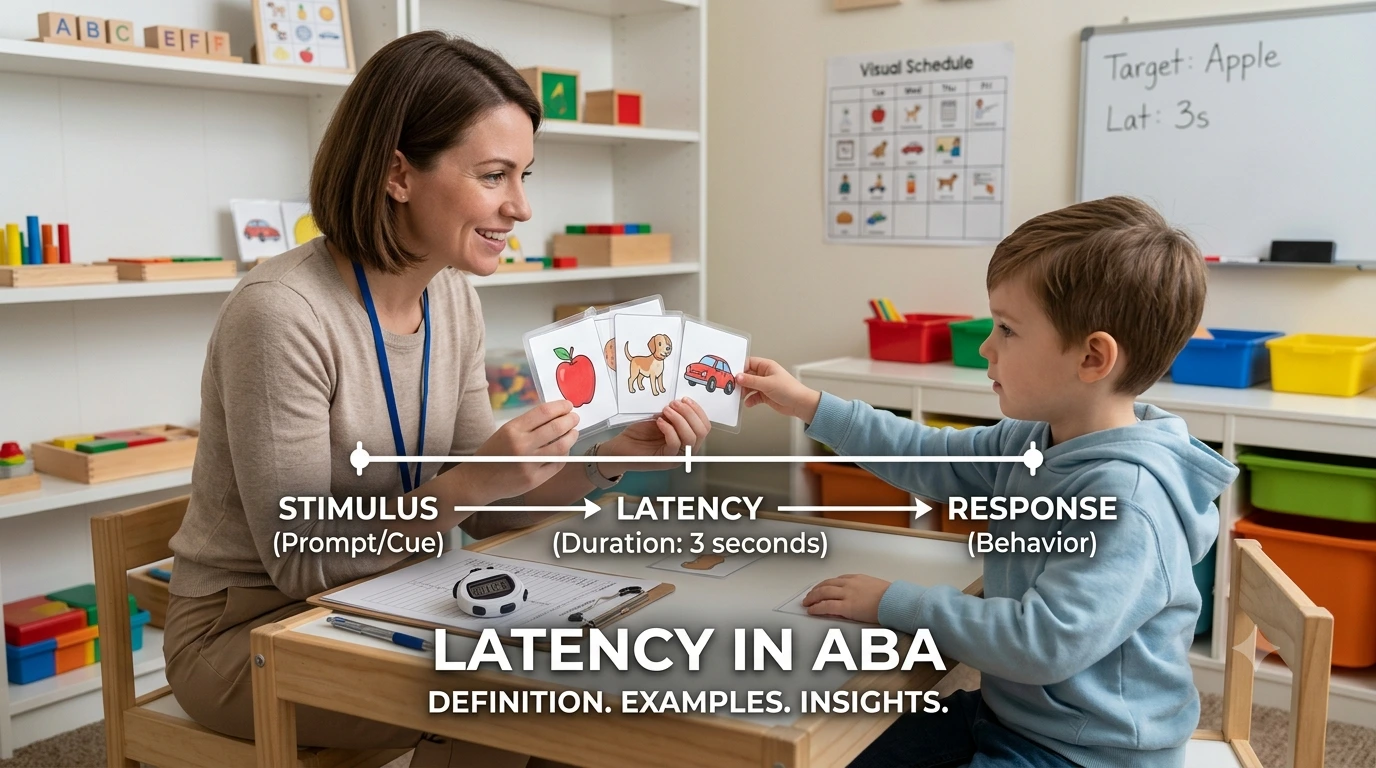
A child’s response time can reveal just as much as the response itself. In Applied Behavior Analysis (ABA), Latency in ABA is the time elapsed from the delivery of an instruction or cue, to the onset of a behavior.
This lag time can be used to monitor learning progress, patterns of responses and the effectiveness of intervention over time. This guide will describe what latency is, its various forms, advantages, data collection methods, and its significance in assessing behavior.
What Is Latency in ABA?
In simple terms, latency in ABA is like a timer that tracks how long it takes for a child to start an action after a request is made. It answers a basic question: “What is the exact time gap between an instruction and the first physical movement?”
It does not measure how long a child throws a tantrum or how many minutes it takes them to finish a whole puzzle. Instead, it is the measurement of the quiet seconds spent waiting for the very first step to begin. Tracking these quiet processing gaps helps clear up one of the common misconceptions about ABA therapy that it only focuses on loud, disruptive actions.
Benefits of Measuring Latency in ABA
Tracking the exact timing of a behavior provides massive benefits that simple counting cannot show.
- Objective Progress Monitoring: It indicates whether the child is in fact improving in a skill based on their speed and ease of learning to do the skill.
- Concrete time information enables supervisors to create learning plans that are just right for the child’s individual processing speed.
- Enhanced Instructional Strategies: Data is provided to teachers to inform them if they need to make words easier to comprehend, so that a child does not get brain fatigued.
- Identifying Prompt Dependency: It is a clear sign that a child knows how to do a task, but deliberately delays performing the task until an adult has been able to provide an easy cue.
- Measuring Learner Independence: When the numbers go down over time, it serves as real proof that a child is gaining confidence and doing things on their own.
- Enhancing Communication Goals: It helps speed up speech patterns so a child can naturally keep up with the fast-paced conversations of other kids.
- Supporting Behavior Reduction Plans: Understanding these time gaps helps teams figure out if a long delay is just a quiet way for a child to avoid a hard task, allowing the team to fix the root cause.
Importance of Latency in ABA Interventions
Tracking latency in ABA is incredibly important because it gives an honest picture of how independent a child is becoming. When we only count if a child can do a task, we miss a huge piece of the puzzle. A student might know how to tie their shoes perfectly, but if they wait a full ten minutes before starting, they will still struggle to get ready for school.
By measuring this exact delay, therapists can see if a child is actually understanding an instruction or just waiting around for help. Narrowing these silent learning moments allows kids to be more confident and fluent in their ability to perform well. It helps make daily routines effortless and stress-free for children to get done so they can get the most out of school and play without always being late.
Solving the timing delays directly benefits a child’s adaptation to life with Autism Spectrum Disorder (ASD). If parents feel like they understand it is a big part of behavioral science, then they can collaborate with clinical teams. This teamwork ensures that the daily lessons are tailored to the child’s exact needs, thereby making the daily routine smoother and helping the child to learn how to live in the world totally independently.
Types of Latency in ABA
Because delays can happen during different parts of the day, clinical teams break latency in ABA down into five distinct types based on what triggers the delay.
Response Latency
This tracks the time between an everyday event in the environment and when a movement starts. It happens naturally without someone giving a direct command. For example, when a loud buzzer sounds at school, the number of seconds it takes for a student to pack up their backpack is a clear example. It helps tracking teams see how well a child reacts to natural cues in the world around them.
Inter-Trial Interval (ITI) Latency
Inter-Trial Interval Latency tracks the specific time between the end of one activity and the start of a brand new task. An experienced ABA therapist Maryland relies on this pause to give kids a small break to breathe or play before jumping back into learning. Keeping this gap consistent is important because if the break stretches out too long, a child might lose focus completely, but if it happens too fast, they can easily get overwhelmed and stressed.
Reinforcement Latency
This records the exact time (in seconds) that passes between a child completing a task and being rewarded with their favorite toy or compliment. In high-quality ABA therapy, speed is crucial, since the student who receives the reward quickly feels that the work is being rewarded with a positive outcome. A long wait can lead to confused children as to why they are being celebrated and thus the lesson becomes ineffective.
Recording Latency During ABA Sessions
When we look closely at how a learning session runs, tracking latency helps us make smart choices that match your child’s needs. Instead of just guessing how well they are doing, looking at these tracked seconds over a few weeks gives us a clear window into their progress.
If those waiting gaps are shrinking, it proves your child is building up real confidence and processing your words much easier. When the wait times stay exactly the same, it is a simple, stress-free sign that the task might be too confusing or hard right now, meaning the team needs to adjust the teaching plan to better support them.
Latency Data Collection Techniques
Depending on the environment and the specific skill being taught, therapists use a few different ways to collect timing data.
Stopwatch Timing
The most common latency recording technique, where a therapist starts a stopwatch immediately after presenting an antecedent or instruction and stops it as soon as the target behavior begins.
Whole Interval Recording
Records whether a behavior occurs for the entire duration of a predetermined interval. It can be used to track behaviors that are required to be sustained throughout the class period, such as staying on task.
Partial Interval Recording
Records whether a behavior happens at any time in the set time, even if it happens for a short time. Often employed to observe problematic and/or high frequency behaviors.
Momentary Time Sampling (MTS)
Records if a behavior occurs at the same time as an interval ends. This method is feasible in classrooms/groups as continuous observation is not essential.
Planned Activity Check (PLACHECK)
Records the number of people doing the same thing at a particular observation time. Often used for measuring group participation and class involvement.
Interpreting Latency Data in ABA
Once the timing data is collected, the clinical team looks at the numbers to understand what the child is communicating through their delays. Reading these patterns helps turn raw seconds into helpful updates for the child’s daily routine.
- Baseline Measurement: Team determines a clear starting point by timing how long it takes for the child to get started on a task before any special teaching is applied. This baseline serves as a yardstick for growth in the future.
- Comparative Analysis: Supervisors analyze the time differences from before the plan was implemented and after. This side-by-side comparison illustrates how much faster the child is running.
- Behavioral Trends:Therapists search the data for consistent patterns (over a few weeks) rather than a single day. These patterns reveal whether the child is learning a skill or getting stuck.
- Individual Approach: The analyst reads the numbers taking into consideration the child’s individual personality, strengths, and needs. One child may need to wait a week, another may require a month, and the plan needs to be tailored to each individual child.
By closely examining this timing information, therapists and carers providing applied behavior analysis Maryland can ensure that every session is as successful as possible, monitor true progress, and initiate positive changes for children with Autism Spectrum Disorder (ASD). A clear, numbers-based approach eliminates the guesswork from therapy to enable families to make good choices for real-world success.
Final Thoughts
It’s important to understand how a child reacts to instructions in order to create an effective therapy plan. The right support begins with a correct evaluation, and customized plans that guide children toward continuous growth over time. If you’re exploring ABA therapy options for your child, Wonder Star ABA is ready to help. Schedule a visit to meet the team, discuss your child’s needs, and learn how individualized ABA services can support their growth and everyday success.