
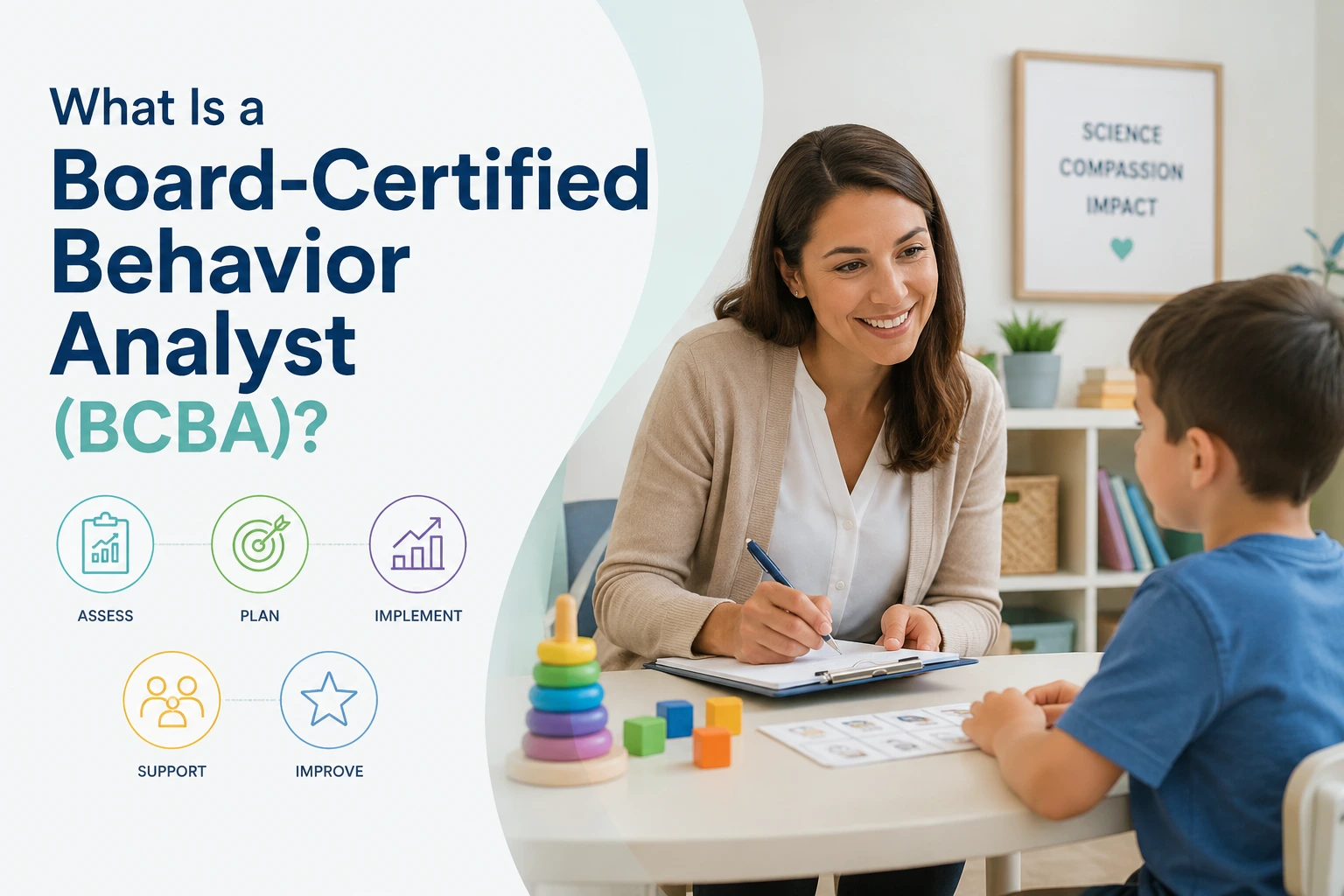
If you start autism therapy, it will begin with a “Board Certified Behavior Analyst” (BCBA). It may seem like a job title, but having a BCBA in the child’s care and development can be beneficial to parents’ understanding.
A Board-Certified Behavior Analyst is a trained individual with a background in behavior who has the skills to teach valuable skills to individuals. They help to develop and monitor behavior intervention programs, particularly for children with autism spectrum disorder (ASD).
In this blog, we will discuss what a BCBA is, what a BCBA does, and why BCBAs are important to many ABA therapy programs.
What does BCBA stand for?
BCBA is a Board Certified Behavioral Analyst. This is a certification provided by the Behavior Analyst Certification Board (BACB).
A BCBA is qualified in behavior assessment, the development of treatment plans, and supervision of the treatment programs, and is trained in behavior analysis.
Many individuals believe that therapists who work directly with children are Board-Certified Behavior Analyst. In most ABA programs, the behavior technician is the therapist who works directly with children. At the same time, the BCBA will be responsible for the overall treatment plan.
What is the role of a BCBA?
The main responsibility of a Board-Certified Behavior Analyst is to develop and oversee behavior intervention programs geared toward teaching the individual the crucial life skills that they need to follow.
Generally, they are engaged in some activity like:
- To comprehend, interpret, and evaluate what they see and hear.
- To gain the ability to recognize strengths and gaps for improvement.
- A treatment plan is created for each person.
- Setting therapy goals
- Monitoring progress
- Supervising therapy staff
The intention is to help individuals develop skills they can incorporate into their lives and, in turn, positively impact their independence.
How does a Behavior Consultant (BCBA) collaborate with children?
Children with autism may have multiple behavioral and developmental needs, which BCBAs can meet.
Before the child begins therapy, the Board-Certified Behavior Analyst will evaluate the child to identify which skills the child has and which the child needs assistance with.
The assessment involves:
- Communication skills
- Social skills
- Daily living abilities
- Learning skills
- Behavior patterns
- Emotional regulation
This information will be used to create a therapy program tailored to the child’s needs and goals.
The development of Individualized Treatment Plans (ITP).
Children are unique, and the way they are treated in ABA therapy Maryland will vary. All children have goals set by a BCBA that are meaningful and attainable.
Some of the goals are:
- Using vocabulary to make requests
- Improving conversation skills
- Following instructions
- Learning self-care routines
- Managing frustration appropriately
Gathering and working with social skills information.
The BCBA will review and update objectives and progress as needed.
Supervising ABA Therapy
Some ABA programs have behavior technicians or Registered Behavior Technicians (RBTs) who are present during therapy sessions with the child. The BCBA will have oversight over these sessions and provide supervision of the therapy sessions.
Responsibilities include:
- Observing sessions
- After therapy, give feedback to therapists.
- Reviewing data
- Updating treatment plans
- To enhance the effectiveness of the therapy.
This supervision helps to ensure quality and consistency in the therapy process.
Supporting Parents & Families
A BCBA can work with the child, but the child can’t be the only person in their support network. They can also work with parents/careers.
It is impossible to implement successful ABA therapy without family members being involved, as children are present in their families and communities for most of the time.
BCBAs can assist with supporting the parents:
- Understand behavior patterns
- Acquire knowledge of successful practice in learning and teaching
- Manage challenging situations
- Work on skills at home with family
- Regularly track and check progress towards goals
This teamwork enables uniformity in therapy and daily life.
What Education Does a BCBA Need?
It takes extensive training and education to become a BCBA.
Most BCBAs complete:
- A bachelor’s degree
- A Master’s Degree in a related field.
- Supervised practical experience
- A certification examination
They must also adhere to a code of conduct and continue their education to renew their certification. This will ensure a continuous flow of information about good practice and research to BCBAs.
Where Do BCBAs Work?
The work of BCBAs can vary by setting, depending on the needs of the people supported.
Common workplaces include:
- ABA therapy centers
- Schools
- Clinics
- Hospitals
- Community programs
- Private practices
- Clients’ homes
Also, some BCBAs provide training and consultation to healthcare professionals and organizations.
Final Thoughts
A Board-Certified Behavior Analyst is an extremely well-trained professional specializing in the understanding and helping people learn important life skills. They assess needs, plan individual treatments, and help with treatment follow-up, and support families in the learning process.
In most children receiving ABA therapy, the entire treatment is managed by the Board-Certified Behavior Analyst. They are aware of how to get the most out of therapy and make it meaningful, effective, and beneficial for the child, ensuring the child is as independent and happy as possible.
Parents and others can be educated about the role of the BCBA to increase their confidence in the behavioral services that they can choose to access and support their child’s development.