
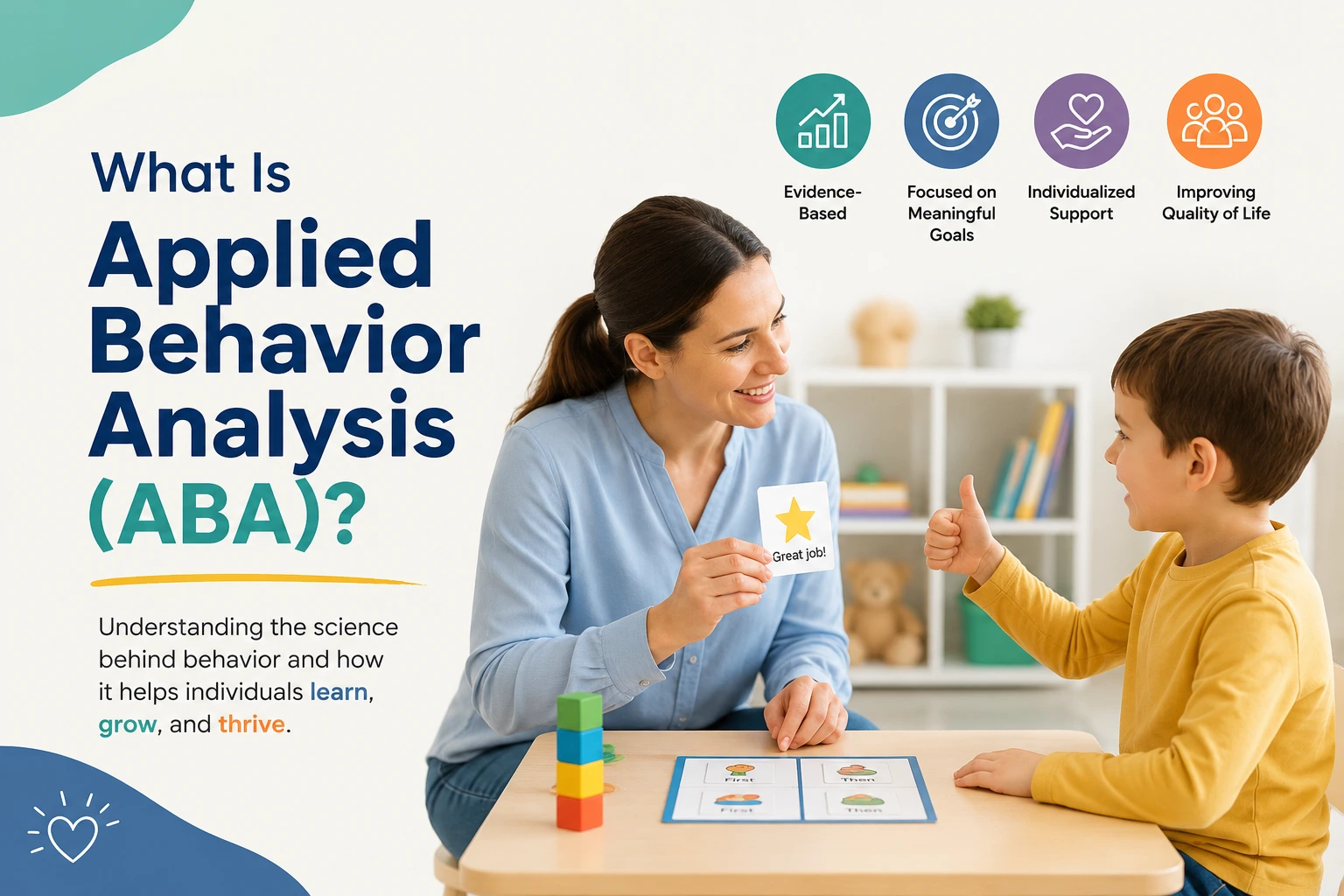
Diagnosing autism may cause you to experience a range of emotions in regard to your child. Love, care, hope, anxiety, and a host of other feelings may come at once. The next problem that comes when you have received the diagnosis is knowing which kinds of therapies will really work for your child.
With so much information available, separating scientifically proven methods from others becomes difficult. There is one therapy that constantly comes up in the case of autistic children. This therapy is known as Applied Behavior Analysis (ABA).
Applied behavior analysis is the most tested and utilized form of therapy when dealing with autistic children. ABA teaches behavior and independence in autistic children. However, modern ABA therapy is quite unlike the extremely rigid systems used earlier.
Contemporary ABA programs are customized to the child’s needs and geared towards enabling them to communicate, interact socially, learn, and live a productive life in an engaging manner. When the child acquires language skills and interacts and befriends other children in school, ABA teaches this in an organized way.
In this article, all topics related to ABA therapy will be covered, including what ABA therapy is, how it works, the types of ABA techniques available, and much more.
What Is ABA?
Applied Behavior Analysis (ABA) is a science-based method that involves the study of behavioral functioning and learning processes. The main aim is to promote useful behavior while limiting behaviors that could hinder learning or communication.
In applied behavior analysis, therapists analyze the relationship between the child’s behavior and the environment in which the child acts. This way, they can become better performers.
For instance, after realizing that one can communicate through words and actions to obtain what he wants, he would definitely try to do so. Due to the success gained from this effort, his abilities would further improve.
The primary difference between ABA therapy and regular therapy is that the former takes into account each individual’s unique needs, while the latter does not. Every person has unique tastes, desires, weaknesses, and talents. A skilled BCBA develops a strategy for an individual child.
The Science Behind ABA
ABA is supported by years of study in the field of behavioral science. The concept behind ABA is that behavior can be trained, rewarded, and changed through instruction and reinforcement.
Yet another critical aspect of ABA involves positive reinforcement. The child acquires a behavior that, when rewarded, they repeat. Positive reinforcement can be given through various means. For example, one could give the child praise along with his toys and games.
The success of ABA in helping kids with autism acquire effective communication skills and social skills is proven by scientific studies.
Why ABA Is Widely Used for Autism Support
How Does ABA Help in Teaching Skills?
Children with autism are often faced with challenges like communication problems, social problems, inflexibility, lack of emotional control, and daily functioning problems. These challenges can be effectively addressed through the ABA method, in which children learn skills aligned with their developmental needs.
Skills that are taught using ABA include:
- Communication skills
- Social interaction
- Play skills
- Daily living activities
- Emotional regulation
- School readiness
- Safety awareness
- Self-help skills
Unlike the previous method of managing behavior by controlling unwanted behavior, the new method of practicing ABA focuses on replacing unwanted behavior with good behavior.
If the child is frustrated and has no idea how to communicate his needs, therapy would focus on helping him ask for them. This will make the child more independent.
The Evidence Supporting ABA Therapy
ABA therapy is considered evidence-based by reputable healthcare and psychological organizations. As noted by the Surgeon General of the United States and the American Psychological Association, ABA therapy has proven to be effective in improving life skills in individuals with autism.
Some of the benefits reported include:
- Language development
- Communication abilities
- Adaptive behavior
- Social functioning
- Academic readiness
One landmark study by Lovaas (1987) demonstrated significant developmental gains among children receiving intensive behavioral intervention.
The Evolution of Applied Behavior Analysis
Early ABA Programs
Applied Behavior Analysis first gained recognition in the late 1960s, courtesy of the efforts of a clinical psychologist named Dr. O. Ivar Lovaas. The earliest ABA therapy programs emphasized extensive structuring, dividing large skills into smaller, easier-to-teach components.
Early therapies were delivered under highly controlled circumstances, in which repetition and rewards were used to teach desired behavior. Such therapies were very intense, involving rigorous procedures.
Although effective, these forms of therapy had limitations since there was a need for a more realistic approach to teaching.
How Modern ABA Has Changed Over Time
Today’s ABA looks very different from earlier versions.
Modern ABA focuses on:
- Child-led learning opportunities
- Natural environments
- Family involvement
- Development of meaningful skills
- Reinforcement of good behavior
- Personalized treatment plans
Treatment is currently being provided through daily activities such as playing, eating meals, going out into the community, and socializing, helping kids practice their newly acquired skills in real-life situations outside therapy.
Current ABA promotes dignity, cooperation, and the acquisition of functional skills.
Core Principles of Applied Behavior Analysis
Positive Reinforcement
Positive reinforcement continues to be one of the most powerful devices in ABA. When a child is rewarded meaningfully for showing an appropriate behavior, there is a high chance that the child will repeat the behavior.
These include:
- Verbal praise
- Favorite toys
- Extra playtime
- Preferred activities
- Stickers or tokens
The reinforcement is carefully selected based on what motivates the individual child.
Task Analysis and Skill Building
Many daily tasks require multiple steps and can be daunting for a child. The principle of ABA uses task analysis, in which larger skills are broken down into smaller, teachable components.
For instance, brushing your teeth might include:
- Picking up the toothbrush
- Applying toothpaste
- Brushing each section of teeth
- Rinsing
- Putting supplies away
Teaching one step at a time often makes learning more successful and less stressful.
Data Collection and Progress Monitoring
Another unique characteristic of ABA is its reliance on data-driven decision-making. The therapists measure objective facts gathered from sessions to monitor progress and make changes where necessary.
Such an approach makes it easy to adjust the program based on each individual’s development. It is easier for parents to notice any change when they have something tangible to point to.
Types of ABA Therapy
Discrete Trial Training (DTT)
Discrete Trial Training (DTT) is among the most structured types of ABA therapies. Each teaching trial follows a clear sequence:
- Instruction
- Child response
- Consequence or reinforcement
For example, a therapist may ask a child to identify a shape. If the child answers correctly, they receive praise or another meaningful reward.
DTT remains effective for teaching foundational skills such as:
- Language development
- Following directions
- Academic concepts
- Matching and identification tasks
Therapists can gather performance information effectively through the structure involved, while ensuring that children develop specific abilities.
Pivotal Response Treatment (PRT)
This therapy takes a different approach from the conventional one because it is more natural. Rather than concentrating on individual behaviors, PRT emphasizes developing certain areas called “pivotal skills.
These include:
- Motivation
- Social engagement
- Self-initiation
- Responsiveness to multiple cues
The therapist focuses on what interests the child and makes use of the natural opportunities to develop his or her skills.
Since learning occurs through enjoyable games, many children tend to remain interested in their therapy sessions. Research indicates that developing pivotal skills leads to overall development.
Early Start Denver Model (ESDM)
The Early Start Denver Model (ESDM) therapy is a combination of both ABA therapy and relationship and developmental therapy.
This therapy is most appropriate for young children, and it comprises:
- Play-based approach
- Social interaction
- Communication development
- Shared engagement
The therapists develop exercises that enable the child to learn through interaction and fun activities. A therapy exercise can serve different development objectives.
While working on a puzzle, for instance, a child will be able to engage in various skills such as communication, fine motor skills, attention, and problem-solving all at once.
Positive results have been recorded among many children after undergoing ESDM at a young developmental age.
Who Benefits from ABA Therapy?
It is common knowledge that ABA therapy helps children with autism, but even the principles behind ABA therapy help individuals of all backgrounds and ages.
ABA may benefit:
- Children with Autism Spectrum Disorder
- Individuals with developmental delays
- Children experiencing behavioral challenges
- People working on communication skills
- Individuals learning independent living skills
ABA’s flexibility allows for interventions specific to the needs, skills, and environment of each person. Many individuals have found that ABA is one way to help children learn the skills necessary to succeed at home, at school, and in society.
What Happens in an ABA Session?
Each ABA session is unique since each child has their own goals.
A session may include:
- Play-based learning activities
- Communication practice
- Social skills training
- Daily living skill development
- Parent coaching
- Behavioral support strategies
Therapists continuously monitor progress while making learning enjoyable and meaningful. Parents frequently have an integral part in their child’s therapy process.
Using the family helps implement skills on a regular basis across varying environments, making it more likely that the skill will generalize to everyday behavior.
Selecting the Correct ABA Program for Your Child
One of the most crucial decisions made by parents after the diagnosis of autism is selecting the correct ABA program for their child.
In selecting a program, take the following into account:
- BCBA supervision
- Individualized treatment plans
- Family involvement
- Data-based progress monitoring
- Best practice methods
- Communication with Caregivers
To develop an effective ABA treatment plan, it is important to consider how your child learns and what makes them special. With Wonderstar ABA Therapy, we offer personalized care to help your child be all they can be.
FAQ’s
What is Applied Behavior Analysis (ABA)?
ABA is an evidence-based approach used to teach and enable individuals to develop new skills, independence, and communication, and to reduce problematic behavior.
What is the definition of ABA?
ABA, or Applied Behavior Analysis, is a behavioral intervention based on scientific principles that facilitates learning.
How can ABA help autistic children?
It helps autistic children learn a variety of skills, both behavioral, communicative, social, and academic.
Is ABA therapy scientifically grounded?
Absolutely. The American Psychological Association and the United States Surgeon General have both classified ABA therapy as evidence-based treatment, relying on many decades of research.
What is the minimum age for undergoing ABA therapy?
A kid may begin ABA intervention at any time in his life, starting in early childhood, when he acquires basic skills.
References: